
A non-custodial transaction is a blockchain transfer authorized solely by the user's private key, giving that user exclusive control over their assets without any third party involved. Unlike sending money through a bank or a centralized exchange, the entire authorization process happens on your device. Tools like MetaMask, Ledger hardware wallets, and Trust Wallet make this possible by storing your private keys locally and signing transactions before they ever touch the internet. Understanding how non-custodial transactions work is the foundation of true crypto ownership, and it separates users who control their assets from those who merely hold an account balance on someone else's server.
How non-custodial transactions work: the step-by-step process
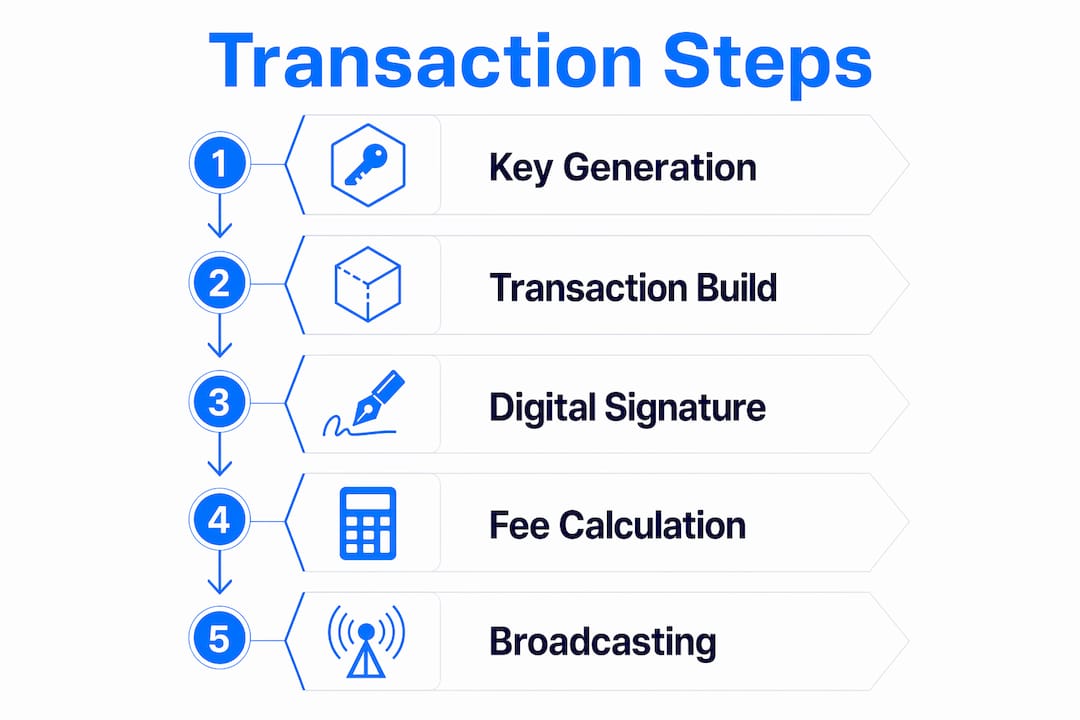
The mechanics behind a non-custodial transaction follow a precise cryptographic sequence. Each step happens either on your device or on the blockchain network itself. No intermediary touches your funds at any point.
1. Key generation and storage When you set up a wallet like MetaMask or a Ledger device, the software generates a private key and a corresponding public key. The private key never leaves your device. Wallets typically display a 12 or 24-word seed phrase once during setup, and losing it means permanent loss of access. That seed phrase is the master backup for every private key your wallet generates.

2. Transaction construction When you send crypto, your wallet builds a transaction object. On Bitcoin, this means selecting specific UTXOs (unspent transaction outputs) as inputs, defining output addresses and amounts, and generating a change output to return leftover funds to your own address. On Ethereum, the model is account-based rather than UTXO-based, so the wallet simply references your account balance and constructs a transfer with a recipient, value, and gas parameters.
3. Digital signature generation Your wallet uses the Elliptic Curve Digital Signature Algorithm (ECDSA) to sign the transaction with your private key. The private key signs locally and is never transmitted or exposed online. The resulting signature proves you authorized the transaction without revealing the key itself. Anyone on the network can verify the signature using your public key, but they cannot reverse-engineer your private key from it.
4. Fee calculation On Ethereum, fees follow the EIP-1559 model introduced in the 2021 London fork. This system sets a base fee with a priority tip, dynamically adjusted per block to stabilize costs. Bitcoin fees are calculated based on transaction size in bytes and current network congestion. Your wallet estimates both automatically, though you can adjust them manually.
5. Broadcasting and confirmation Once signed, your wallet broadcasts the transaction to the blockchain network. It enters the mempool, a waiting area of unconfirmed transactions, until a miner or validator includes it in a block. After inclusion, subsequent blocks add confirmations. Bitcoin typically requires 6 confirmations for high-value transfers; Ethereum finalizes faster under proof-of-stake.
| Step | What happens | Where it occurs |
|---|---|---|
| Key generation | Private and public keys created from seed phrase | Your device |
| Transaction construction | Inputs, outputs, amounts assembled | Your wallet software |
| Signing | ECDSA signature applied using private key | Your device (offline capable) |
| Broadcasting | Signed transaction sent to network nodes | Internet/blockchain network |
| Confirmation | Transaction included in a block and finalized | Blockchain |
Pro Tip: Test every new wallet setup by sending a small amount first. Confirm receipt before moving larger holdings. This catches address errors and network mismatches before they cost you real money.
What are the security responsibilities of non-custodial transactions?
Non-custodial ownership is defined by private key control, not by wallets holding coins. That distinction carries serious weight. You gain full sovereignty, but you also absorb every risk that a bank or exchange would otherwise manage for you.
The core risks break down into three categories:
- Seed phrase loss or theft. If someone obtains your 12 or 24-word recovery phrase, they own your funds. There is no fraud detection or transaction reversal available. No support team can help. The loss is permanent and irreversible.
- Phishing and malicious approvals. Fake websites mimic legitimate DeFi protocols and prompt you to sign transactions that drain your wallet. Advanced token permission systems like Permit2 create delegated spending rights that can transfer control of your tokens to an attacker with a single signature. Reading what you sign is not optional.
- Malware and device compromise. Keyloggers and clipboard hijackers target crypto users specifically. Many non-custodial wallets counter this by keeping private keys strictly local, decrypting only within isolated signing modules. Hardware wallets like Ledger and Trezor go further by performing all signing inside a secure element chip that never exposes the key to the connected computer.
- Smart contract permissions. Even with full key control, smart contract approvals can move assets without your ongoing consent. Approving a malicious contract is functionally the same as handing over your keys.
The benefit side is equally significant. No counterparty risk means no exchange hack, no platform insolvency, and no account freeze can touch your funds. The 2022 collapses of FTX and Celsius demonstrated exactly what happens when users trust custodians with their keys.
Pro Tip: Store your seed phrase on metal, not paper. Products like Cryptosteel or Bilodeau plates survive fire and water damage. Keep the backup in a location separate from your primary device.
Is non-custodial safer than custodial? A direct comparison
Custodial wallets store your keys on their servers and sign transactions on your behalf. Non-custodial wallets hold keys locally and give you direct signing power. Neither model is universally safer. The right choice depends on your technical confidence and how much risk you can manage yourself.
| Feature | Custodial | Non-custodial |
|---|---|---|
| Key control | Held by third party | Held by user |
| Transaction reversal | Sometimes possible | Never possible |
| Account recovery | Via email/ID verification | Via seed phrase only |
| Counterparty risk | High (exchange failure, hacks) | None |
| User error risk | Low (support available) | High (no recovery) |
| Privacy | Lower (KYC required) | Higher |
| Best for | Beginners, frequent traders | Long-term holders, DeFi users |
Custodial services like Coinbase or Binance offer convenience, customer support, and recovery options. They also require KYC verification, hold your keys, and can freeze your account. Non-custodial wallets offer privacy and sovereignty at the cost of full personal responsibility.
Hybrid approaches are gaining traction. Multi-party computation (MPC) wallets split the private key into shares held by multiple parties, so no single point of failure exists. Social recovery wallets, pioneered by Argent on Ethereum, let you designate trusted contacts who can collectively restore access if you lose your device. These models blend both custody types without fully surrendering control.
How to use non-custodial wallets safely
Getting started with non-custodial transactions requires more than downloading MetaMask. Safe execution depends on habits built before you move a single dollar.
1. Back up your seed phrase before funding the wallet. Write it down during setup. Verify it by restoring the wallet on a second device before depositing anything. Never store it in a cloud service, email, or screenshot.
2. Send a test transaction first. Before transferring significant value, send a small amount to confirm the address, network, and wallet configuration are correct. Blockchain transactions are irreversible, so a $5 test is cheap insurance.
3. Verify recipient addresses character by character. Clipboard malware replaces copied addresses with attacker-controlled ones. Always check the first four and last four characters of any address before confirming. On hardware wallets like Ledger, verify the address on the device screen itself, not the computer display.
4. Separate your wallets by purpose. Use one wallet for DeFi and NFT interactions, where you regularly sign contracts. Use a separate wallet, ideally a hardware wallet, for long-term savings. This limits exposure: if a DeFi approval drains your hot wallet, your savings remain untouched.
5. Audit and revoke token approvals regularly. Tools like Revoke.cash and Etherscan's token approval checker let you see every contract you have authorized to spend your tokens. Remove approvals you no longer need.
6. Keep wallet software updated. Developers patch security vulnerabilities in wallet firmware and software regularly. Running outdated versions leaves known attack vectors open. This applies to both software wallets like MetaMask and hardware wallets like Trezor.
Pro Tip: Enable biometric authentication and a strong PIN on any mobile wallet. These add a physical barrier against unauthorized access if your phone is stolen.
Key takeaways
Non-custodial transactions give users complete asset control through local private key signing, but that control requires active security management to prevent irreversible loss.
| Point | Details |
|---|---|
| Private key = ownership | Whoever controls the private key controls the assets. No key means no access. |
| Signing happens locally | Your wallet signs transactions on your device; the private key is never transmitted. |
| No recovery without seed phrase | Losing your 12 or 24-word phrase means permanent loss. Back it up offline immediately. |
| Custodial vs. non-custodial trade-off | Non-custodial offers sovereignty; custodial offers convenience and recovery support. |
| Safe signing is the core skill | Reading and understanding what you sign matters more than which wallet you choose. |
Why the real skill is what you sign, not what you use
Most crypto education focuses on wallet selection. Pick Ledger over a software wallet, use MetaMask over a lesser-known alternative. That advice is not wrong, but it misses the more important point.
I have watched technically sophisticated users lose funds not because they chose the wrong wallet, but because they signed something without reading it. A Ledger device will not save you if you approve a malicious Permit2 signature on a phishing site. The hardware confirms what you authorize. It does not evaluate whether the authorization is wise.
The shift I find most significant right now is the move toward MPC wallets and social recovery. These tools reduce the catastrophic single point of failure that makes non-custodial ownership so intimidating for new users. Argent's social recovery model and MPC implementations from providers like Fireblocks (originally built for institutions) are now reaching consumer products. That matters because the biggest barrier to self-custody is not technical complexity. It is the fear of losing everything to a single mistake.
My honest view: the abstraction layer is getting better, but it is not good enough yet to remove the need for education. Understanding the mechanics of how a transaction is constructed, signed, and confirmed is still the most reliable protection against the attacks that actually drain wallets in 2026. Tools improve. Attackers adapt. The user who understands the process will always be harder to fool than the user who trusts the interface.
— Ahmed
Buy USDT instantly with full wallet control
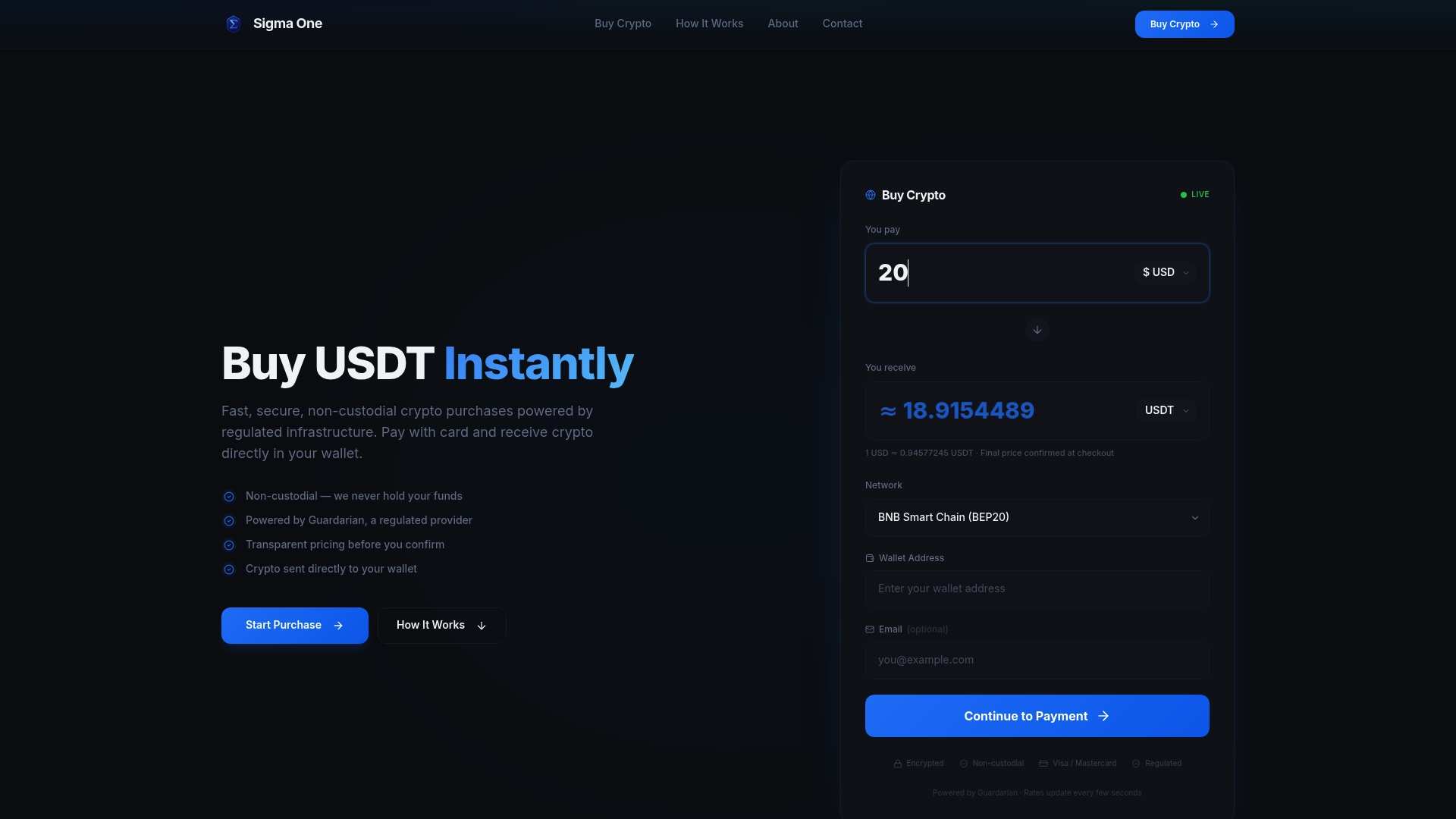
If you want to put non-custodial principles into practice, the first step is acquiring crypto that goes directly to your wallet. Sigma-one processes USDT purchases through Guardarian, a regulated payment service, and delivers funds straight to your wallet address on TRC20 or ERC20 networks. No exchange account. No custodian holding your funds. Fees and exchange rates are displayed before you confirm, so there are no surprises at checkout. You can buy USDT instantly and see exactly how the non-custodial delivery process works, or go directly to secure your purchase when you are ready.
FAQ
What are non-custodial transactions?
Non-custodial transactions are blockchain transfers authorized by the user's own private key, with no third party involved in signing or custody. The user's wallet constructs and signs the transaction locally before broadcasting it to the network.
How do non-custodial wallets differ from custodial ones?
Custodial wallets store your private keys on a company's servers and sign transactions on your behalf, while non-custodial wallets keep keys on your device and give you direct signing authority. The key difference is who controls authorization.
What happens if I lose my seed phrase?
Losing your seed phrase means permanent loss of access to your funds. There is no customer support, password reset, or recovery process available for non-custodial wallets.
Are non-custodial transactions reversible?
No. Once a signed transaction is confirmed on the blockchain, it cannot be reversed or canceled. This is why verifying recipient addresses and transaction details before signing is critical.
What is the safest way to store a private key?
The safest approach combines a hardware wallet like Ledger or Trezor for transaction signing with an offline, physical backup of your seed phrase stored in a separate secure location. Never store your seed phrase digitally.