
Secure crypto transaction best practices are the specific steps every cryptocurrency holder must follow to prevent permanent asset loss, unauthorized transfers, and wallet compromise. The stakes are real: a single mistake, whether it's a miscopied address, an unlimited token approval, or a weak authentication method, can wipe out a portfolio with no recourse. This guide covers the full security stack, from hardware wallets like Ledger and Trezor to transaction simulation tools like Rabby Wallet, authentication apps like Google Authenticator and Authy, and permission auditing tools like Revoke.cash. Follow these practices and you move from reactive to proactive in protecting your crypto.
1. Secure crypto transaction best practices start with hardware wallets
Hardware wallets are the single most effective defense for anyone holding crypto beyond a few hundred dollars. Devices like Ledger and Trezor keep private keys offline, meaning no internet-connected attack can reach them. Even if your computer is fully compromised by malware, your keys stay protected inside the device.
Buying from official sources matters as much as owning the device. A hardware wallet purchased from a third-party reseller may arrive with tampered firmware or a pre-generated seed phrase already known to the seller. Always order directly from Ledger.com or Trezor.io, inspect the packaging seal, and verify device integrity before first use.

Firmware updates are not optional. Manufacturers regularly patch security vulnerabilities, and running outdated firmware is equivalent to leaving a known door unlocked. Set a reminder to check for updates monthly.
Backup strategy is where most users cut corners. The 3-2-1 backup rule means three copies of your seed phrase, stored on two different media types, with one copy offsite. Metal seed phrase storage products like Cryptosteel or Bilodeau protect against fire and water damage that paper cannot survive. Encrypted backups on offline USB drives add a second layer of redundancy.
- Buy only from official manufacturer websites
- Verify packaging integrity and device authenticity before setup
- Update firmware immediately after purchase and monthly thereafter
- Store seed phrases on metal, never digitally or in cloud storage
- Keep one backup copy in a separate physical location
Pro Tip: Never photograph your seed phrase or type it into any device connected to the internet. The moment it touches a network, it is compromised.
2. How to implement multi-factor authentication and anti-phishing measures
SMS-based two-factor authentication feels secure but is not. The FBI reported nearly $26 million in losses tied to SIM-swap attacks in a single year. In a SIM swap, an attacker convinces your mobile carrier to transfer your phone number to their device, intercepting every SMS code you receive. This makes SMS 2FA a liability, not a protection.
App-based authenticators like Google Authenticator and Authy generate time-based codes locally on your device, with no carrier involvement. They are significantly harder to intercept. For the highest level of protection, hardware security keys like YubiKey provide physical authentication that cannot be remotely cloned or phished.
Exchanges like Binance offer anti-phishing codes, a unique string you set yourself that appears in every legitimate email from the platform. If an email arrives without your code, it is a phishing attempt. This one setting eliminates an entire category of attack.
- Replace SMS 2FA with Google Authenticator, Authy, or a YubiKey immediately
- Enable anti-phishing codes on every exchange that supports them
- Use a dedicated email address exclusively for crypto accounts
- Use a password manager like Bitwarden or 1Password to generate and store unique passwords per platform
Pro Tip: If you use Authy, disable multi-device sync unless you actively need it. Leaving it on creates an additional attack surface.
3. What to verify before confirming any crypto transaction
Transaction verification is where most avoidable losses happen. The most critical check is the destination wallet address. Always verify the first and last six characters of the address manually before confirming. Attackers use address poisoning to place near-identical addresses in your transaction history, hoping you copy the wrong one.
Network selection is equally critical. Sending USDT on the ERC20 network to a TRC20 address, or vice versa, results in permanent loss. Confirm the blockchain network and token standard match what the recipient expects before you sign anything.
For any transfer above a threshold you would genuinely feel, send a small test transaction first. The cost of a test transaction is trivial compared to the cost of a misdirected large transfer. This practice is especially important when sending to a new address for the first time.
Transaction simulation tools change the game entirely. Blind signing a transaction is the equivalent of signing a blank check. Wallets like Rabby Wallet simulate the full transaction before you confirm, showing you exactly which tokens move, in which direction, and what contract permissions are being granted. Never approve a transaction you cannot read in plain language.
- Copy the destination address, then manually verify the first and last six characters against the source
- Confirm the correct blockchain network and token standard
- Send a small test transaction before any large transfer to a new address
- Use a simulation-capable wallet like Rabby Wallet to preview token flows
- Reject any transaction request that does not display readable details
Pro Tip: Treat any wallet interaction that asks you to approve an action you did not initiate as a phishing attempt. Legitimate platforms never push unsolicited approval requests.
4. Why managing smart contract permissions matters
Every time you interact with a decentralized application, you grant it permission to move tokens from your wallet. Most dApps request unlimited token approvals by default, meaning a single compromised dApp can drain your entire token balance. This is one of the most underappreciated risks in crypto security.
Revoke.cash and the Etherscan Token Approval Checker both display every active approval on your wallet address. You can see which contracts have permission to spend your tokens and revoke any that are unnecessary or unfamiliar. Running this audit takes less than five minutes and should happen at least once a month.
When a dApp prompts you for an approval, set a specific spending cap rather than accepting the unlimited default. If you are swapping $200 worth of tokens, approve $200 worth, not unlimited. This limits your exposure if that contract is later exploited.
- Audit all active token approvals monthly using Revoke.cash or Etherscan
- Revoke permissions for any dApp you no longer actively use
- Set specific spending caps instead of accepting unlimited approvals
- Treat any approval request from an unfamiliar contract as suspicious
Pro Tip: After using any new or experimental dApp, revoke its permissions immediately. The risk window closes the moment you remove access.
5. How wallet segregation and address management enhance security
Maintaining distinct wallets for different purposes is one of the most practical safe crypto transaction methods available. Wallet segregation prevents total portfolio loss if one wallet is compromised. A single wallet that holds your long-term savings, receives daily payments, and interacts with experimental dApps is a single point of failure.
The table below shows a practical three-wallet structure that covers most individual use cases.
| Wallet type | Purpose | Security level |
|---|---|---|
| Cold storage wallet | Long-term holdings, rarely accessed | Hardware wallet, maximum protection |
| Daily use wallet | Regular transactions, moderate balances | Software wallet with 2FA enabled |
| Burner wallet | Interacting with new or risky dApps | Minimal balance, disposable |
Address poisoning deserves specific attention. Attackers send micro-transactions from addresses that closely resemble your frequent contacts, then wait for you to copy the wrong address from your transaction history. The defense is simple: never copy recipient addresses from your transaction history. Use a verified address book or scan a QR code directly from the recipient.
Withdrawal whitelists on exchanges restrict outflows to pre-approved addresses only. Even if an attacker gains access to your account credentials, they cannot send funds to an address that is not on your whitelist. Setting this up takes minutes and adds a meaningful barrier against unauthorized withdrawals.
Key takeaways
Secure cryptocurrency transactions require hardware wallet isolation, layered authentication, manual address verification, and regular permission audits working together as a system, not as isolated steps.
| Point | Details |
|---|---|
| Hardware wallets are foundational | Use Ledger or Trezor for any portfolio worth protecting; buy only from official sources. |
| Replace SMS 2FA immediately | SIM-swap attacks cost users millions annually; switch to Google Authenticator, Authy, or YubiKey. |
| Verify addresses manually | Always check the first and last six characters of a destination address before confirming. |
| Audit token approvals monthly | Use Revoke.cash or Etherscan to remove unnecessary dApp permissions and set spending caps. |
| Segregate wallets by purpose | Separate cold storage, daily use, and dApp interaction wallets to limit exposure from any single compromise. |
Why I think most crypto security advice misses the point
Most security guides focus on tools and skip the discipline. You can own a Ledger, run Authy, and still lose everything because you copied an address from your transaction history or approved an unlimited token spend without reading it. The tools are only as good as the habits around them.
What I have found actually works is treating every transaction as adversarial until proven otherwise. That sounds paranoid, but it is the correct mental model. Attackers are patient. They build fake dApps that look identical to real ones, send micro-transactions to poison your address history, and wait for you to move fast. Slowing down costs you thirty seconds. Moving fast can cost you everything.
The boring operational hygiene that security professionals emphasize, things like monthly permission audits, withdrawal whitelists, and dedicated email accounts, matters more than any single tool. It is not exciting. It does not make for good social media content. But it is what actually keeps funds safe over years of active use.
My personal recommendation: set a recurring monthly calendar event called "crypto security audit." In that session, check firmware updates, run Revoke.cash, review active sessions on your exchanges, and confirm your seed phrase backups are intact. Thirty minutes a month is a reasonable price for protecting assets you worked to acquire.
— Ahmed
Buy USDT securely with Sigma-one
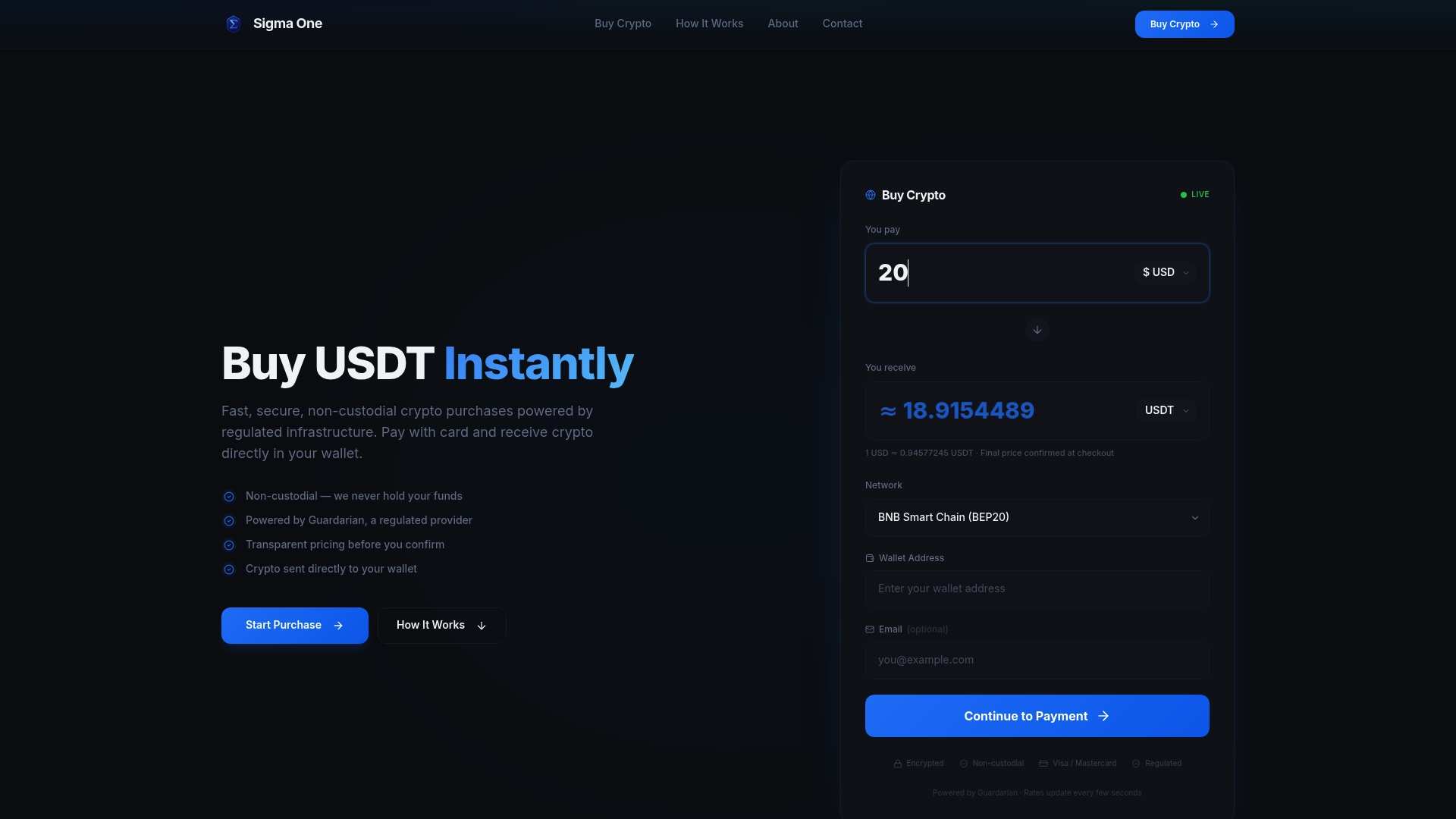
Sigma-one is built for exactly the kind of user this article describes: someone who wants to buy crypto without handing control of their funds to an intermediary. Sigma-one processes purchases through Guardarian, a regulated payment service, and delivers USDT directly to your wallet on TRC20 or ERC20 networks. You maintain full custody from the moment the transaction completes. Fees and exchange rates are displayed before you confirm, so there are no surprises. If you are ready to buy USDT securely or want to understand the full process first, see how it works before committing.
FAQ
What is the safest way to store crypto private keys?
Hardware wallets like Ledger and Trezor store private keys offline, making them inaccessible to network-based attacks. Pair device storage with a metal seed phrase backup stored in a separate physical location.
Why is SMS two-factor authentication risky for crypto accounts?
SMS 2FA is vulnerable to SIM-swap attacks, where attackers redirect your phone number to intercept verification codes. The FBI linked nearly $26 million in losses to SIM swapping in one year, making app-based or hardware-key authentication the safer choice.
How do I check and revoke smart contract permissions?
Visit Revoke.cash or use the Etherscan Token Approval Checker, connect your wallet, and review every active approval. Revoke permissions for contracts you no longer use and set specific spending caps on any new approvals.
What is address poisoning and how do I avoid it?
Address poisoning is an attack where malicious actors send micro-transactions from addresses that closely resemble your contacts, hoping you copy the wrong one from your history. Avoid it by using a verified address book or QR codes instead of copying from transaction records.
Should I send a test transaction before large transfers?
Yes. Sending a small test transaction before any large transfer to a new address confirms the address is correct and on the right network. The minor cost of the test transaction is negligible compared to the risk of permanent loss from a misdirected transfer.